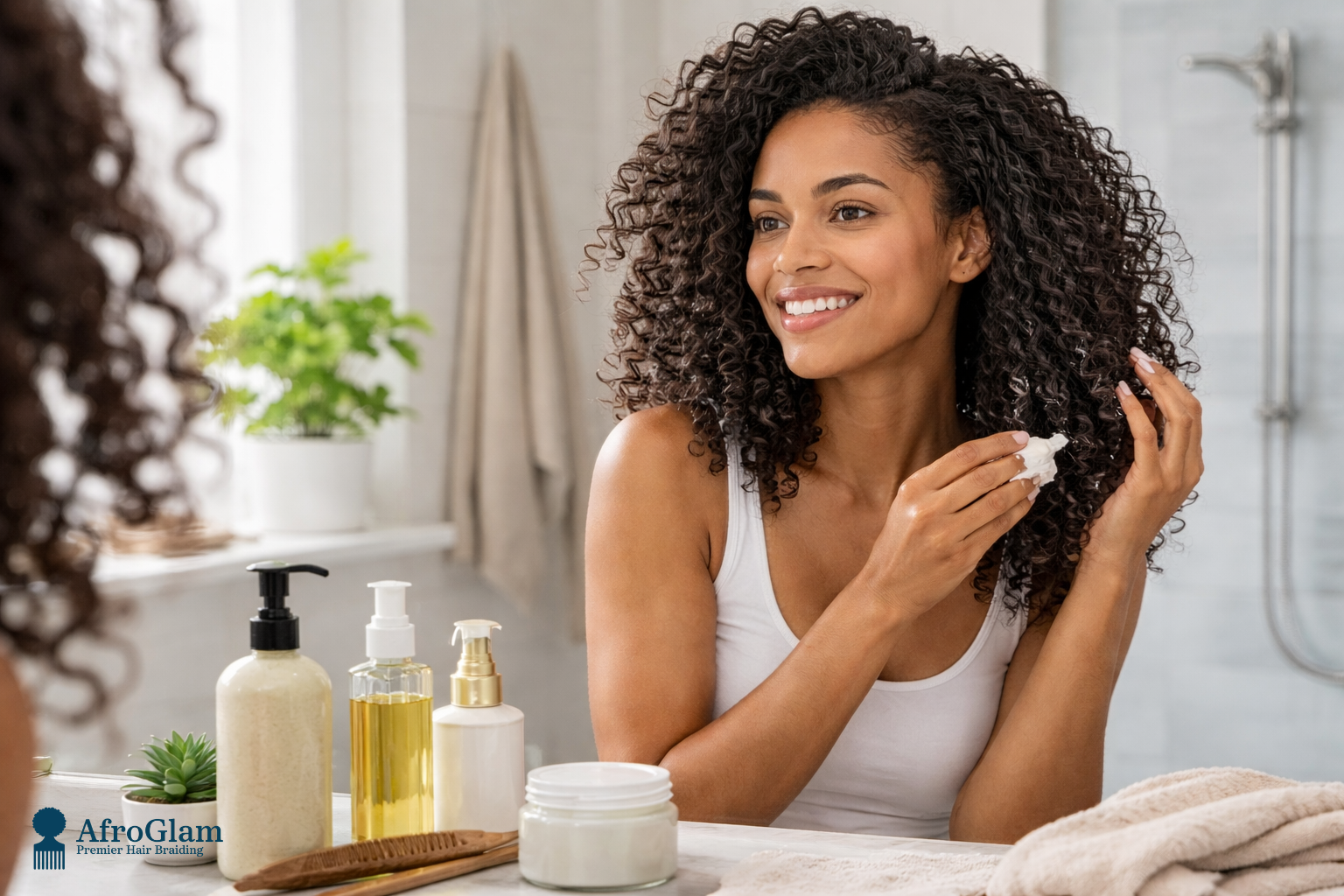
Starting a natural hair routine doesn’t have to be a headache. Often, the easiest routines are the best because they’re simple to stick with, manage, and tweak as your hair changes with the seasons, styles, or your growth goals. Ever wonder why a product works perfectly one month and not the next? It usually boils down to consistency, keeping your hair moisturized, and understanding what your hair really needs.
This guide is here to help you set up a practical natural hair routine focused on keeping your hair healthy, helping it grow, and giving you the freedom to style as you please. You’ll learn how to figure out what your hair type and porosity are, wash your hair without stripping it dry, condition deeply and wisely, detangle with less damage, protect your hair at night, and make smart choices when it comes to braids and other protective styles. If you want some professional help, AfroGlam Hair Braiding offers services like hair wash, regular twist, and knotless braids to fit into a healthy natural hair care plan.
When it comes to caring for natural hair, it’s helpful to get advice beyond what product ads tell you. According to the U.S. National Library of Medicine, both how you style your hair and how you handle it physically affect its health. That’s why being gentle is so important in daily routines. You can learn more about general hair and scalp health from their hair care resources. Remember, the goal isn’t perfection; it’s finding a routine that you can keep up with and trust.
Start with Your Hair Type, Porosity, and Daily Needs
Why curl pattern alone is not enough
Thinking that natural hair care is all about curl pattern is a common mistake. There’s more to it. Factors like density, strand width, porosity, and scalp condition also play a big role in how your hair reacts to water, oils, creams, and heat. Two people might have similar curls but need completely different routines because one person’s hair soaks up moisture quickly, while another’s doesn’t or loses it just as fast.
Hair porosity is crucial because it affects how easily water gets into the hair and how long it stays there. Low-porosity hair often resists getting wet and might need lighter products or warm water to open up, while high-porosity hair might benefit from richer products for sealing and deeper conditioning. Knowing your porosity helps you choose products with a purpose instead of guessing and buying too much.
How to observe what your hair is telling you
A simple starting point is to watch how your hair behaves after washing. Does it dry fast, feel rough soon after you moisturize, or soak up conditioner almost immediately? These signs tell you a lot about your hair’s moisture needs. If your scalp gets itchy soon after wash day, maybe your routine needs more cleansing. If your ends are dry even though the rest feels soft, you might need more sealing and nighttime care.
To tailor your routine, think about your hair goals instead of trends. Are you trying to grow your hair, reduce breakage, stretch the time between washes, or define your curls more consistently? Once you know your goal, designing your routine becomes easier. If you need a style that doesn’t require much daily fuss but still looks polished, options like boho braids or cornrows might fit without compromising your hair care priorities.
Build a Cleansing Routine That Supports the Scalp
Why cleansing matters for natural hair
A healthy natural hair routine starts with a clean scalp because buildup can mess with how well your hair absorbs moisture and how comfortable your scalp feels. Product residue, sweat, hard water minerals, and dirt from the environment can all settle into curls and coils, making your hair feel dull or weighed down. Regular cleansing helps reset your hair so treatments can work effectively.
But don’t overdo it. Washing too much can strip your hair of the natural oils that protect it. A balanced schedule might mean shampooing once a week or every two weeks, depending on your styling habits, scalp activity, and how much product you use. If your routine includes oils, creams, gels, or edge control, a gentle but consistent cleansing pattern usually boosts results over time.
Shampoo, co-wash, and clarifying at the right time
Many natural hair routines rely on sulfate-free shampoos for regular cleansing because they clean without being too harsh. Between wash days, co-washing with a cleansing conditioner can refresh your curls and help maintain moisture. Once a month, a clarifying shampoo can help remove stubborn buildup that regular washing doesn’t fully lift.
The American Academy of Dermatology emphasizes that scalp care should be gentle and consistent, especially when dealing with dryness or irritation. Their hair and scalp guidance reminds us that healthy hair starts with a healthy scalp. If you’re going through a period of intense sweating or frequent styling, a professional hair wash can be a smart reset.
Moisturize, Seal, and Layer Products Correctly
The logic behind hydration layering
Moisture is the key to soft, manageable natural hair, but hydration works best when layered strategically. Water-based products introduce moisture, oils seal it in, and creams or butters help reduce evaporation and boost softness. This is why many natural hair routines use the LOC method (liquid, oil, cream) or the LCO method (liquid, cream, oil).
The right method depends on your hair’s porosity and how your strands respond to product weight. Fine hair might get weighed down by too much butter, while coarse or high-porosity hair might need richer products to stay hydrated longer. Test one change at a time to see what actually works. You don’t need a ton of products; you need a sequence that suits your hair.
Best ways to apply leave-in, oil, and cream
After washing, apply a water-based leave-in conditioner to damp hair. This gives your strands a moisture base that’s easier to maintain throughout the week. Next, apply a light natural oil like jojoba, olive, or argan oil to lock that moisture in. Finish with a cream or butter if your hair needs extra softness, definition, or protection from dry air.
For those who want styles that keep hair tucked away while looking great, touch-up braids and extended ponytail options can help reduce daily fuss. Protective styling works best when the hair underneath stays moisturized and cared for, not ignored. That’s why the routine matters even when your hair is braided, twisted, or tucked under a wig.
Deep Condition and Strengthen Without Overdoing It
What deep conditioning actually does
Deep conditioning is one of the most valuable steps in a natural hair routine because it helps restore softness, manageability, and elasticity. After washing, your hair absorbs nourishing ingredients better, especially when heat or a warm cap is used. A deep conditioner with moisturizing ingredients can make detangling easier and cut down on the dryness that leads to breakage.
Most people benefit from deep conditioning at least once a week or every other wash, especially if their hair is color-treated, heat-styled, or often exposed to environmental stress. If your hair feels limp or overly soft, you might need to balance moisture with protein. If it feels dry, brittle, or breaks easily, you might need more hydration. Listening to your hair is more useful than following a rigid schedule that ignores its condition.
When protein treatments are helpful
Protein treatments aren’t necessary every week, and using them too often can make hair stiff or dry. But occasional protein support can help strengthen weak strands and improve resilience, especially if you notice frequent snapping or loss of elasticity. For many people, a monthly protein treatment or a treatment used as needed is enough to keep hair balanced.
To get the most out of a deep conditioner, apply it in sections, cover your hair with a shower cap, and use a hooded dryer or heat cap if appropriate. Heat improves product penetration, but it should always be used cautiously. If your routine includes regular salon support, ask about sew-ins or cornrows for wig when you want a style that protects your hair while keeping your routine manageable.
Detangle Gently and Minimize Breakage
Why detangling technique matters
Breakage often happens during detangling, especially when hair is dry, rushed, or pulled from root to tip without sectioning. Natural hair is strongest when handled with patience and slip, meaning the hair has enough moisture or conditioner to let tangles release more easily. The gentler your detangling process, the more length you keep over time.
Always detangle on damp hair or hair with conditioner in it. Use your fingers, a wide-tooth comb, or a flexible detangling brush, and work in small sections. Start at the ends and move upward slowly. If you hit a knot, separate it carefully instead of forcing the tool through it. This one habit can dramatically reduce breakage over the course of a year.
Best tools and sectioning habits
Sectioning makes detangling faster and more organized because you aren’t fighting your whole head at once. Divide the hair into four to eight parts depending on thickness, clip each section away, and complete one area before moving to the next. This method also helps you notice shedding, dryness, or fragile ends earlier.
If your hair tangles easily, consider styles that reduce daily handling. Regular twist styles can be a practical option because they protect the ends and make maintenance easier between washes. For families managing younger hair, especially if you're considering a child-friendly style, kids cornrows braids can be helpful when installed with care and maintained properly.
Choose Protective Styles That Support, Not Stress, Your Hair
What makes a protective style truly protective
Protective styles aren’t automatically protective just because hair is braided or tucked away. A style should reduce daily handling, protect the ends, and avoid tension at the scalp. If a style is installed too tightly, kept in too long, or neglected during wear, it can cause breakage or traction stress instead.
Popular options include braids, twists, bantu knots, wigs, and weaves, but the best choice depends on your lifestyle and hair goals. The style should be comfortable enough to wear without pain, flexible enough to maintain, and easy enough to remove safely when the time comes. For a style that balances beauty and function, knotless braids are often preferred because they can look natural while reducing tension at the base.
How long to keep styles in and how to maintain them
Most protective styles shouldn’t stay in longer than six to eight weeks. After that, buildup, matting, and tension can begin to undermine the benefits. While wearing the style, moisturize the scalp gently, protect the hair at night with satin or silk, and avoid tugging on the roots. If you need a refresh instead of a full takedown, a service like touch-up locs or touch-up braids can extend the life of the style without causing unnecessary stress.
It’s also worth remembering that professional organizations like the National Institutes of Health note that traction-related hair loss can occur when styling repeatedly pulls on the roots. This information is especially useful if your routine includes braids, ponytails, or other long-term styles.
Trim, Protect, and Care for Your Hair at Night
Why regular trims support growth
Hair doesn’t grow faster because it’s trimmed, but trims help keep the length you already have by removing split or weak ends before they travel upward. Most natural hair routines benefit from trimming every six to eight weeks, although the exact timing may vary depending on heat use, styling habits, and your ends’ condition. If your ends feel thin, rough, or snag easily, that’s often a sign they need attention.
Protective styling can reduce how often you need to handle your ends, but it doesn’t replace trims. Healthy ends help styles last longer and make wash day easier. If you wear long styles regularly, it might also be smart to pair trims with a gentle removal process like hair extensions take down so you don’t cause extra breakage during unraveling.
How nighttime care protects all your progress
Nighttime care is one of the easiest and most overlooked parts of natural hair maintenance. Cotton pillowcases can soak up moisture and increase friction, while satin or silk reduces both issues. Wrapping hair with a satin scarf or bonnet, or sleeping on a satin pillowcase, helps preserve styles and keep hair softer until morning.
If your hair feels dry before bed, a light re-moisturizing step might be enough to keep it comfortable overnight. Avoid heavy product buildup at night because it can make hair greasy or attract lint. Consistency matters here: a simple nightly habit is often more valuable than a complicated treatment used only once in a while.
Adapt Your Routine to Houston Weather and 2026 Hair Trends
Humidity, frizz, and seasonal changes
Weather affects natural hair more than many realize. In humid conditions, hair may swell, frizz, or lose definition more quickly, while dry indoor air can create the opposite problem. Houston humidity, in particular, can challenge even a well-planned routine, which is why anti-humidity products, lightweight stylers, and protective styles can be especially useful.
The best response is to prepare your routine around the season rather than fighting your hair every day. In humid weather, use styles that hold shape well and avoid over-layering oils that may attract residue. In drier months, focus more heavily on hydration and sealing. The science behind weather-sensitive hair behavior is tied to moisture exchange and cuticle structure, which is why many people see different results from the same products depending on the season.
Natural hair trends that support low-maintenance styling
In 2026, natural hair trends continue to move toward texture-friendly, low-maintenance looks that celebrate natural movement rather than hiding it. Styles such as lived-in bobs, dimensional brunette tones, soft curls, boho-inspired finishes, and easy-to-refresh protective styles are popular because they look intentional while remaining realistic for everyday life. You can explore broader beauty trend insights through Allure’s hair trend coverage and then adapt those ideas for your own routine.
For clients who want a salon style that aligns with these trends while still caring for natural hair, crochet braids and cornrows boho can create a fashionable look with manageable upkeep. The point is not to chase every trend. It’s to choose styles that complement your texture and protect the work you have already done.
Common Mistakes That Break the Routine
Overwashing, product overload, and tight styles
Even a good routine can fail if interrupted by common mistakes. Overwashing can dry out the hair, while product overload can leave residue that makes curls limp and hard to refresh. Tight styles, especially when worn repeatedly, can stress the hairline and create long-term damage. When these habits stack up, the result is usually frustration and inconsistency.
Another common issue is constantly switching products before giving any one routine enough time to work. Hair usually needs several wash cycles to show its true response. Before replacing products, evaluate whether the problem is the formula, the application method, or another step in the routine. Sometimes the answer is simpler than expected.
How to troubleshoot dryness, shedding, and buildup
If your hair feels dry, first check whether you’re moisturizing on damp hair and sealing properly afterward. If shedding seems excessive, compare your detangling method and styling tension. If buildup is the issue, a clarifying wash may be more useful than adding another cream or oil. Troubleshooting works best when you isolate one variable at a time.
Salon support can also help you reset when your routine gets off track. AfroGlam Hair Braiding offers services that can support maintenance and protection, including box braids, kinky twists, and free style options for clients who want customized protection with a polished look. If you’re based in Houston, having a trusted salon partner can make it easier to stay consistent year-round.
Simple Weekly Routine You Can Actually Follow
A realistic example schedule
If you want a routine that’s easy to maintain, start with something simple. On wash day, cleanse, deep condition, detangle in sections, and apply leave-in plus your preferred sealant. Midweek, refresh your scalp if needed and lightly mist your hair with water or a water-based spray before adding a small amount of moisturizer. At night, protect the hair with satin or silk and avoid pulling it into tight styles while sleeping.
On a monthly basis, clarify your hair, inspect your ends, and reassess whether your current products still match your porosity and styling habits. Every six to eight weeks, consider a trim if the ends are splitting or thinning. This kind of schedule keeps the routine manageable without making it feel like a full-time job.
When to get professional help
Sometimes the simplest routine is the one that includes professional help at the right time. If your hair needs a reset, if your scalp is irritated, or if you want a long-lasting style that reduces daily effort, a salon visit can be part of your care plan rather than a luxury. Professional braiders can also help you choose styles that support your goals, whether that means simplicity, length retention, or a more polished finish.
For a deeper look at how style choice affects maintenance, you might also want to read Protective Styles: What They Are, How Long They Last, and How to Choose the Right One for Your Hair and Common Mistakes That Can Damage Natural Hair. These related guides can help you build a complete care system instead of treating each wash day as a fresh start with no structure.
Conclusion: Keep It Simple, Consistent, and Hair-Friendly
A simple and effective natural hair routine isn’t about using the most products or copying someone else’s regimen step for step. It’s about understanding your hair, cleansing it thoughtfully, keeping it moisturized, detangling it gently, and protecting it from unnecessary stress. Once those foundations are in place, everything else becomes easier to manage.
If you stay consistent, your hair will begin to show you what it needs more clearly. You’ll notice when it likes lighter products, when it needs more sealing, when a trim is due, and when a protective style will help you reach the next stage of your goals. That confidence comes from routine, not guesswork.
Whether you’re building your first regimen or refining one that no longer feels right, AfroGlam Hair Braiding is here to help with professional services and practical care. Explore our hair wash, regular twist, and knotless braids options to support your natural hair journey, and contact us when you’re ready for a style that looks beautiful and respects your hair’s health. For expert guidance and salon service in Houston, visit our team and make your next hair routine easier to follow and easier to love.